.png?width=552&height=414&name=Choosing%20a%20Math%20Curriculum%20(2).png)
The Case for Strong Elementary Math Foundations
Strong elementary math foundations begin with understanding, not memorization.
When students move from hands-on...

However, since that time, it has gained a following among classroom teachers, and the increasing attention of researchers and educators concerned about equity, learning loss, teaching language learners, and developing a 21st-century workforce with a high degree of science literacy and competence.
As more research has been undertaken, PBL has been shown to have an even wider influence on children’s learning that its developers originally expected. Among many other benefits, it has been shown to contribute to language learning and science literacy, social-emotional learning, problem-solving in other subjects, and communication skills. Recent research has also shown that it helps decrease the learning gap for underserved populations.
Let’s unpack what PBL is, how it works in the classroom, what the research says about its benefits, and some of the resources available to curriculum leaders who want to implement PBL in their school or district.
Put simply, project-based learning is a way for students to actively engage in learning by tackling a real-world question or problem together. More formally, it is defined as “a teaching method in which students gain knowledge and skills by working for an extended period of time to investigate and respond to an authentic, engaging, and complex question, problem, or challenge.”
While PBL can be applied to any discipline, it is uniquely suited to teaching science. As Dr. Joseph Krajcik, a pioneering PBL researcher and educator at Michigan State University, comments, “Kids, unfortunately, are [traditionally] introduced to science like it’s a body of knowledge. But science is so much more than that! Science is all about trying to figure out how things work.”
How exactly is PBL different from traditional science education?
In a sense, it turns teaching on its head and follows the precept of “Eat Dessert First.” In traditional teaching, the teacher presents phenomena and scientific concepts in a lecture format, then demonstrates with an experiment or project as a sort of treat or “dessert,” which students may participate in themselves or simply observe.
This approach requires little active engagement or thinking on the part of the students, but rather simply absorption of the information being presented and, in the case of projects like dioramas or posters, a product that may be creative but does not require active scientific inquiry, critical thinking, or collaboration. The hands-on portion of the lesson, if there is one, is intended to demonstrate material that has already been presented and learned, rather than being a process of discovery.
PBL reverses the process and makes the project the “main meal,” presenting the students with a problem and giving them the time and tools to explore, understand the boundaries and limitations of the problem, brainstorm, test, and develop a solution or conclusion themselves. It is an interdisciplinary process, where students will often need to apply content knowledge and skills from multiple academic domains to the project.
As they apply their knowledge and skills in a new context and engage in inquiry, they engage in a level of academic rigor that builds their critical thinking abilities. And as they complete and present their projects, they develop a level of independence, confidence, and ownership of their work that provides a firm foundation for future studies and workplaces.
Furthermore, in PBL, the process is just as important as the content, as the students are learning a number of important behaviors and skills as they work with the content. At the core of PBL is a foundational set of behaviors, called the four C’s:
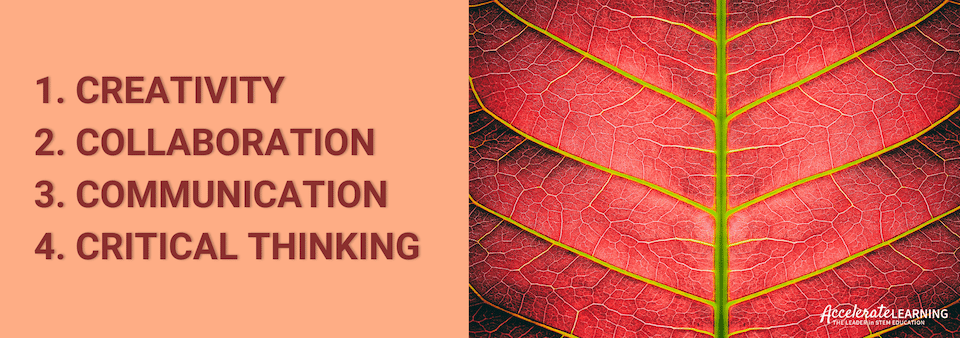
These skills (creativity, collaboration, communication, and critical thinking) are applicable well beyond the domain of the sciences as well as the classroom, laying the foundation for a competent 21st-century workforce and a civil society better equipped to resolve its differences.
As might be expected, the impact on the classroom and the teacher’s role is profound. Let’s take a look at the way a typical PBL activity is structured.
Unlike traditional science teaching strategies, following a PBL approach involves starting with a real-world problem or situation and then coaching the students through a scientific process of discovery toward potential solutions. As Dr. Krajcik comments, “In many respects, project-based learning mirrors what scientists do, trying to answer a really important question or to figure out what’s going on with some phenomena.” The stages of this process are described below.
While these stages will vary with the project, the individual teacher’s teaching style, and the age of the students, it’s important that teachers allow adequate time for each step, assemble resources effectively, and plan their own approach to leading discussions of the problem and potential solutions as they develop science lesson plans.
There is a wealth of PBL science classroom ideas available on the internet, particularly on sites devoted exclusively to PBL. Some great resources include Edutopia and the Lucas Foundation. Examples of these STEM science activities include:
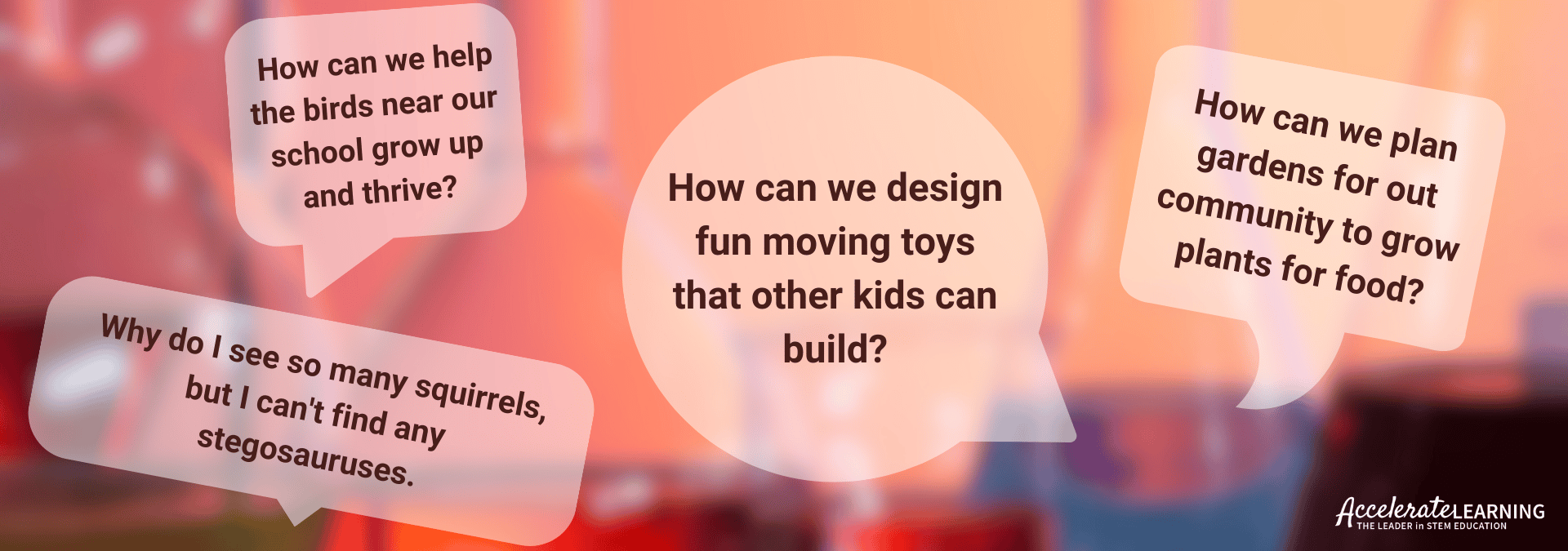
As is apparent from these examples, PBL requires teachers to take on a very different role than the traditional teaching approach taught in most education programs and practica. Education blogger Maggie O’Brien comments that “the role of the teacher shifts from content-deliverer to facilitator/project manager.”
This requires a different kind of preparation. For example, when making a science lesson plan, the teacher must choose a project with the appropriate level of complexity, that will enable students to achieve the desired learning outcomes, and is relevant to the students’ interests. They may need to prepare resources, including drawing on other school staff such as media specialists, plan the way they will introduce the problem, and anticipate difficulties or obstacles students may encounter during their explorations. Finally, the teacher may also need to prepare students for working within the PBL format: they may need to practice group processes like active listening, discuss rules of behavior, and consider taking on different roles or tasks within the group. and a comfort level with managing the unexpected
One risk of using PBL without adequate preparation is that the students will enjoy the process, but not learn the content and skills they are intended to absorb. Clearly, implementing PBL so that the students are not only engaged but also meet content and process learning goals requires strengthening a different set of teaching muscles. Zachary Herrmann, University of Pennsylvania researcher and co-author of Core Practices for Project Based Learning: A Guide for Teachers and Leaders, writes that teachers may find the work of making project-based learning successful “overwhelming and intimidating.” Herrmann and his colleagues studied teachers applying PBL and found that the most successful employed three important practices:
They paid attention to eliciting students’ higher-order thinking, challenging them with “why” questions and asking them to synthesize and contextualize.
These researchers commented, “[I]f we’ve learned anything from reform efforts of the past, it’s that if we fail to support teachers, our efforts at change will likely fail. Why? Because teachers and teaching are the keys to transforming what happens for kids in schools.”
For this reason, high-quality, multidimensional, in-depth professional development is an essential determinant of success among districts that adopt PBL as a science teaching strategy. The focus is to help teachers learn to be facilitators of learning rather than the traditional authoritative role of teacher-centered instruction.
The benefits of a successfully implemented project-based learning approach to students are myriad, addressing some of the American education system’s most deep-seated issues today—lack of student engagement in learning, equity—especially equity in science—and the deep divides in achievement between well-served and underserved districts, learning loss, the challenge of multilingual learners, struggling students, and differently-abled students, teachers competing with the magnetic pull of digital devices and the internet, and the need for districts to demonstrate achievement through standardized testing at both a state and national level.
Among the benefits promoted by PBL advocates are:
PBL is highly engaging, piquing students’ interest and requiring them to actively engage in the work, applying critical thinking skills and interacting with their peers, while thinking creatively to solve problems. Because teachers choose projects that are based in real-world problems, often from their local physical or political environment, PBL activities are relevant to students with a wide variety of backgrounds and interests.
PBL helps build 21st-century skills students need to succeed in other school subjects, college, work, and adult life. The skills they learn through PBL are transferable to other domains. Critical thinking, inquiry, teamwork, rigorous research and analytical skills, discourse, and presentation skills are only a few of the skills that will serve students well, whatever their academic or career path as adults.
Students learn and practice critical 21st-century teamwork behaviors like collaboration, communication, compromise, and active listening. They also learn project management, delegation of tasks, and mutual responsibility for each other in order to achieve a good team outcome.
It is multidisciplinary, simultaneously drawing on and building skills in subject areas like language arts, math, science, and social sciences, as well as social-emotional skills and collaborative skills. All of these mirror real life, both in the workplace and academia, and prepare students for living in the greater world.
PBL has been shown to close the achievement gap for students in underserved demographics and low-achievement districts (see more on this research below). Because of its interactive, hands-on approach and the emphasis on collaboration and teamwork, it is also believed to benefit students who are multilingual learners or have differing learning styles, such as visual or kinesthetic learners.
Students build their creative capacity to work through difficult, ill-structured, and open-ended problems that mirror the real world and prepare them for academic and workplace settings. Since they have to consider the assumptions and constraints of the scenario as they frame the problem, students learn to structure a problem themselves, enhancing their ability to transfer learning from one context to others.
Students gain experience taking initiative and responsibility for their own learning. As they're pushed to use research, creativity, and higher-level critical thinking, they develop “grit” and other skills that apply to their future academic and work life.
Students recognize the intrinsic rewards of solving a problem. With PBL, students earn more than a grade: they gain self-respect and satisfaction for completing a project by answering a question, solving a real-world problem, or creating an innovative solution.
Increasingly, academic researchers are substantiating these claims. Given the extent of change PBL requires in teaching strategies and classroom management, researchers have been investigating whether this approach brings measurable benefits to students, or addresses some of the pressing issues in education today mentioned above.
In particular, recent research at the University of Michigan has found that implementation of PBL—which includes a strong emphasis on teacher professional development and alignment with NGSS standards—in elementary classrooms has a strong and lasting effect on reading and science achievement as well as aspects of social-emotional learning. The researchers commented,
This improvement [in science knowledge] regardless of reading level is notable because it shows that rigorous project-based learning coupled with professional learning is effective for all learners. Additionally, the fact that these significant effects persisted across schools with differing racial and ethnic makeups and household-income statuses and in various regions of the state further substantiates the claim that this approach is beneficial for all students.
At the other end of the age spectrum, two recent major studies of high school Advanced Placement classes, funded by Edutopia’s sister division Lucas Education Research, show that project-based learning was an effective strategy for all students, outperforming traditional curricula not only for high achieving students, but across grade levels and racial and socioeconomic groups.
With further rigorous research focusing on the impact of PBL on equity, retention of skills over time, achievement on critical standardized tests, and other touchpoint issues in education today, the impact of PBL as a science teaching strategy and as a focus of professional development will become increasingly clearer.

Strong elementary math foundations begin with understanding, not memorization.
When students move from hands-on...
As Back-to-School kicks into gear, we’re highlighting how to build great STEM classrooms and set your school year up...

The strongest start to a STEM school year isn’t about decorating a classroom or creating a perfect syllabus.
It comes...


