.png?width=552&height=414&name=Choosing%20a%20Math%20Curriculum%20(2).png)
The Case for Strong Elementary Math Foundations
Strong elementary math foundations begin with understanding, not memorization.
When students move from hands-on...

.png?width=342&height=260&name=image%20(2).png)
The strongest start to a STEM school year isn’t about decorating a classroom or creating a perfect syllabus.
It comes from preparing yourself as a teacher: building routines that support inquiry, planning for the range of learners who will enter your classroom, and committing to your own ongoing growth.
The most effective back-to-school tips for teachers treat the first weeks as the beginning of a year-long cycle, not a one-time setup task.
When classroom systems, instructional strategies, and professional goals are intentionally planned before students arrive, teachers create a foundation that supports learning long after the first weeks of school.
So, what makes a strong start to the school year for STEM learners? Let’s unpack it.

A strong start comes from preparing the teacher, not just the classroom.
The way a STEM classroom is organized, the routines students practice, and the expectations established in the first weeks all influence how well the learning unfolds throughout the year.
“In a STEM classroom, your setup should be about creating a space where students can ask questions, test ideas, collaborate with classmates, and engage in hands-on problem solving”.
There’s an important difference between reactive and intentional preparation.
Reactive preparation can look like scrambling through a checklist before the students arrive: bulletin boards, name tags, printed materials, desk arrangements. Intentional preparation focuses on building systems that make learning possible all year.
That means thinking beyond day one and creating a classroom environment where students know how to collaborate, engage, and see themselves as capable problem-solvers. That's the throughline of the back-to-school tips for teachers we’ll be sharing here.
The goal is to create conditions for curiosity, collaboration, and growth throughout the entire school year.

One of the most practical places to begin back-to-school preparation is the physical classroom.
In a STEM classroom, your setup should be about creating a space where students can ask questions, test ideas, collaborate with classmates, and engage in hands-on problem solving.
A thoughtful STEM classroom setup removes barriers between students and learning.
Here are a few ideas:
Every one of these choices should connect back to classroom goals around discourse and investigation, not just visual tidiness.
|
Setup Move |
Why It Matters |
|
Flexible grouping arrangement |
Supports collaboration and group problem-solving |
|
Accessible manipulatives station |
Removes barriers during hands-on activities |
|
Designated investigation space |
Creates a place for exploration and inquiry |
|
Visible class norms |
Reinforces expectations throughout the year |
|
Materials labeled and stocked |
Keeps activities running smoothly from week one |
Routines are what make hands-on, inquiry-based STEM instruction possible.
Without them, exploration turns into chaos fast. Materials go missing, groups argue over roles, and the investigation you planned takes twice the time you budgeted.
Here are a few routines worth teaching explicitly in the first weeks:
Practicing routines takes time at the beginning of the year, but that investment pays off. A classroom that knows how to work together within that space can spend more time exploring concepts and less time on transitions.
These routines create the foundation for the kind of STEM learning where students ask questions, investigate problems, develop solutions, and communicate their thinking.
This reflects the importance of putting investigation and design at the center of learning, where students build understanding through authentic inquiry and problem solving.
Establishing the collaborative norms that these routines depend on is also an important part of building a math community in your classroom, where students learn to share ideas, explain their reasoning, and engage with one another.

Every STEM classroom includes a range of readiness levels, multilingual learners, and students with different learning needs.
Planning for that is a back-to-school task, not something to address after challenges appear.
“Practicing routines takes time at the beginning of the year, but that investment pays off.”
The strongest STEM classrooms are designed with access in mind from the beginning. That means creating multiple ways for students to engage with ideas while maintaining high expectations for every learner.
Here are a few practical strategies to consider before the school year begins:
These early decisions also help students build a strong math identity, too. When students see that their reasoning (not just their answer) is valued from the beginning, they're more willing to take the intellectual risks that math and STEM learning overall requires.
For new teachers, the beginning of the school year can feel overwhelming. There are lessons to plan, classroom routines to establish, and relationships to build.
“The strongest STEM classrooms are built over time and supported by collaboration and shared expectations across a grade level or department.”
The most helpful new teacher tips focus on doing a few important things well rather than trying to perfect every detail before students arrive.
Start with these high-impact systems:
It's normal not to have everything figured out in August. Strong systems matter more than perfect materials.
And leaning on an existing curriculum rather than building everything from scratch can reduce planning demands, giving new teachers more time to focus on students and their learning.
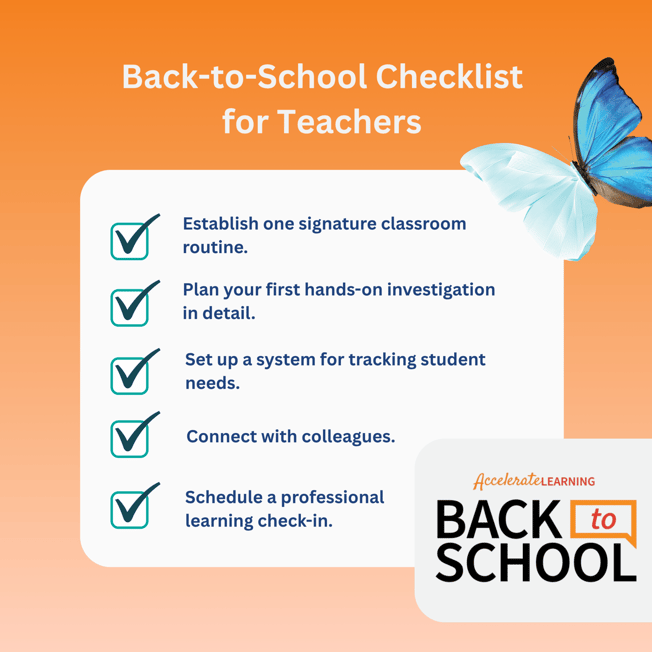
A realistic back-to-school checklist for teachers doesn't need to cover everything. It just needs to cover the moves that matter most:
This is a starting set, not a full overhaul. The strongest STEM classrooms are built over time and supported by collaboration and shared expectations across a grade level or department.
Classroom setup and routines launch the year, but ongoing learning sustains it.
A strong start to the STEM school year is the beginning of a year-long cycle of growth for students and their teachers.
The classrooms that have the greatest impact are shaped over time through thoughtful routines, responsive instruction, and teachers who continue learning alongside their students.
For teachers ready to build on a strong start, Accelerate Learning’s STEM professional learning opportunities provide ongoing support through flexible learning experiences designed around educators’ needs.
Build your STEM teaching plan for the year ahead.
Explore STEM professional learning options that help educators strengthen instruction, build confidence, and support student success.
Strong elementary math foundations begin with understanding, not memorization.
When students move from hands-on...

As Back-to-School kicks into gear, we’re highlighting how to build great STEM classrooms and set your school year up...

The strongest start to a STEM school year isn’t about decorating a classroom or creating a perfect syllabus.
It comes...


