.png?width=552&height=414&name=Choosing%20a%20Math%20Curriculum%20(2).png)
The Case for Strong Elementary Math Foundations
Strong elementary math foundations begin with understanding, not memorization.
When students move from hands-on...

Today’s students are struggling in math.
Frustrations are building in the classroom, teachers are trying new techniques hoping they stick, and administrators are trying to explain to stakeholders why scores are dropping.
While schools can turn to any number of math improvement strategies to help boost scores, many of these techniques don’t get to the heart of what students lack: a positive math identity.
Ahead, we’ll tackle this complex and often misunderstood topic to explore how to help students build a strong math identity with practical classroom strategies that foster math confidence.

Setting a student up for long-term success in math starts by fostering their positive math identity. Do they actually see themself as a “math person,” or are they constantly battling that inner voice that says “math just isn’t for me”?
Students start developing their math identity through daily experiences in and out of the classroom–from their first class all the way to graduation.
These experiences influence whether a student feels they belong in math, if they’re capable of succeeding, and if math is relevant to their lives.
“Students build their math identity–either positive or negative–based on what being “good at math” looks like in the classroom.”
Math identity isn’t tethered to skill. Rather, students who have a positive math identity find their confidence in process and discovery more than efficiency and grades.
Schools and teachers play a major role in fostering students’ math identity–from classroom activities, to counseling, to course recommendations.
Teachers have the ability to disrupt students’ existing “math baggage” they bring into the classroom, changing negative perceptions about math into opportunities for growth.
Research confirms what most teachers already know intuitively: math is just as emotional as it is cognitive.
Despite a student’s natural cognitive growth after primary school, for instance, the transition to high school often leads to lower math involvement.
Even with a high learning potential, many older students fall into patterns of avoidance and disengagement with math, suggesting that success in math requires more than skill alone.
Students also need motivation and confidence for long-term success.
When students are confident in their abilities, they’re more likely to persist through challenges, participate in class, and maintain a growth mindset.
“The more intentional schools and teachers can be about daily math experiences, the greater opportunity students will have to develop a positive math identity.”
Teachers should take time to assess their students’ relationship with math, and note that identity gaps often follow demographic lines.
Students from diverse cultural or learning backgrounds are often fed negative narratives about their belonging in math. Teachers should purposefully push against these narratives in favor of confidence-building techniques that encourage students’ sense of belonging.
Students build their math identity–either positive or negative–based on what being “good at math” looks like in the classroom. Who gets called on, which answers are valued, and whether or not students feel they belong in the class are all building blocks in their math identity.
The more intentional schools and teachers can be about daily math experiences, the greater opportunity students will have to develop a positive math identity. Teachers’ choices around curriculum, pacing, and instruction all feed into a student’s perception of what it means to succeed in math.
Here’s what those 3 key elements in math success matter in math identity:
Remember that both positive and negative math identity is built from small, daily experiences–starting from their first math class and continuing through their entire learning journey.
It’s important to empower students in math early on, and pay close attention to the subtle ways students are forming their math identities over the years.
Here’s how teachers can help students form a strong math identity. It’s all about:
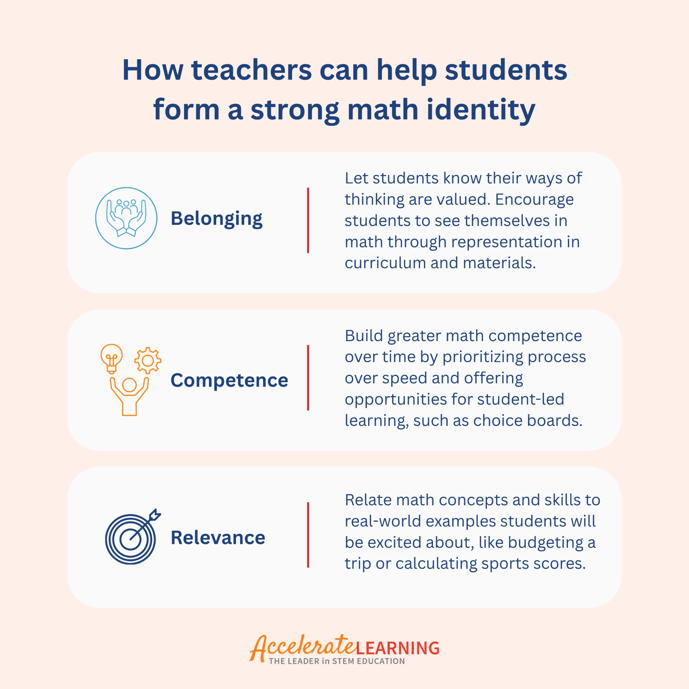
As students form their math identity, they’re looking for signals around them.
Who’s doing math successfully? Can I relate to those people? Do I feel welcomed in the classroom?
Students use these social and instructional cues to make conclusions about their math capabilities and belonging.
Culturally responsive teaching that reflects students’ unique backgrounds and abilities is a major building block to a positive math identity.
When students see peers and teachers who share similarities succeeding in math, it signals to them that they’re capable of being “math people” too.
“While math identity might sound abstract, it’s built from the actionable daily moves teachers make in the classroom.”
Representation in materials and instruction is key to math confidence, but it doesn’t end there; it’s also built through teachers’ responses to student thinking.
When teachers respond positively to student input, students learn how to use their own voice in math, and that different perspectives are welcomed.
The Impact of Productive Struggle on Identity
The math strategies teachers use on struggling students can help or harm their math identity.
It’s important to find the sweet spot in letting students struggle.
Feeding answers to students without much effort on their part sends the signal that they’re not capable of figuring it out themselves, and it gives the impression that success is solely determined by accuracy and speed, rather than effort and strategy.
Showing students that it’s OK to struggle productively, to challenge themselves within appropriate parameters and a teacher’s guidance, helps them build resiliency and confidence.
While math identity might sound abstract, it’s built from the actionable daily moves teachers make in the classroom. Encouraging student ownership, making math relevant, and establishing supportive math discourse all come from the practical strategies teachers use in their instruction and classroom culture.
Here are some daily practices teachers can do to build their students’ positive math identity.
“Student choice” is more than a buzzword–it’s a practical strategy that helps shape students’ math identity.
When students have some autonomy over their learning, they discover that their voices and ways of thinking are valuable.
Open-ended tasks, multiple-solution paths, and student-led discussions give students the space to approach problems in their own way, giving them a deeper sense of ownership and confidence.
Cultivating strong student voices not only increases classroom engagement, it also builds a more durable, positive math identity over time.
Teachers should consider creative approaches to student-led learning that give students autonomy and flexibility, while still aligning to standards.
This could look like:
Students use math every day. Comparing purchase prices, calculating drive times, measuring ingredients–these daily math experiences feel like a normal part of life.
Yet when students walk into the classroom, they see a different “math world” where they might not belong.
Math feels strict, unrelatable, and confined to right and wrong answers, rather than personal growth and problem-solving.
It’s up to teachers to help bridge the gap between real-life math and classroom math–showing students that the skills they’re learning have relevant, daily applications.
Consider exercises like:

Making math relatable can be as involved as a unit-long project on starting up a pretend business, or something as simple as connecting fractions to their favorite food.
Regardless of the concept on the agenda, teachers should look for creative ways to keep math relevant and engaging.
Math discourse plays a powerful role in a student’s math identity. In productive math discourse, students learn through classroom discussion that their ways of thinking are valid and that success in math can be found through multiple learning pathways.
When teachers validate students’ ways of thinking by naming and discussing their strategy (“Maya’s approach”), it boosts their confidence and publicly reinforces their identity as math thinkers.
Facilitating supportive math discourse is a daily commitment. Students should feel confident that the classroom is a welcoming place for listening, expressing ideas, and collaboration.
Discourse norms that build up over time shape the way students perceive their sense of belonging in math. Who talks, who is heard, and what strategies are valued are all signals students use in shaping their math identity.
The subtle ways teachers communicate with and instruct students are important building blocks for math identity and confidence.
Think about the ways teachers introduce new concepts, how they respond to students’ ways of thinking, the activities and opportunities they offer, and the social norms they cultivate in the classroom. Teachers aren’t just teaching content; they’re signaling who belongs and who can succeed.
Teachers’ mindset about student potential is foundational to helping (or harming) students’ math identity. Beliefs centered around fixed ability can infiltrate communication with students, even in subtle ways.
Though most teachers are well-meaning, the setbacks of fixed-ability messaging can be long-lasting. This could look like discouraging students from pursuing advanced courses, dismissing different learning strategies, or favoring certain students over others.
Building an identity-affirming classroom doesn’t happen overnight. It takes intentional practice and reflective teaching. While most identity building takes place in the classroom, it’s a school-wide effort supported through professional learning, instructional coaching, and collaborative planning.
Schools that adopt inquiry-based math instruction, like Wilemon STEAM Academy, help students develop a greater sense of belonging and ownership in math. Second grade teacher at Wilemon, Amy Nutt, had this to share about her students:
“One of the biggest differences I see is in the excitement of the kids. They are smiling when they walk in the door every day. They genuinely want to be here because they're so involved in their learning."

How can teachers recognize which students are building a positive math identity, and which ones are struggling?
Since the path to a positive math identity is gradual, it’s important for teachers to look for subtle signs in their students over time.
Look for students who take risks, ask questions, and persist through challenges.
Students who show these signs are building a positive math identity that will flow into larger, long-term outcomes over time, like course-taking patterns, career pathways, and lifelong numeracy.
Schools that work towards a culture of positive math identity will set their students up for greater success, not just in the classroom, but as lifelong learners and problem-solvers.
Austin ISD is one of many districts seeing the positive impact of math confidence in their schools. Jennifer Jones, director of Elementary STEM, reports:
"Students are becoming more confident, and teachers feel more confident in math, too. I don't see the same anxiousness, or pushback, or constant questioning of 'Why are we doing this?' Instead, everybody's in."
Encouraging students to own their positive math identity is a rewarding task for educators. The experiences we offer students, both big and small, have long-lasting effects on their academic, career, and life choices.
Instilling math confidence isn’t just an abstract idea–it requires professional learning and intentional planning.
For schools and teachers wanting to learn more about math identity, check out our 6 Pillars of Math Confidence guide for practical tips and classroom strategies.
With the right mindset and tools, you can start instilling a positive math identity in students right now.
Strong elementary math foundations begin with understanding, not memorization.
When students move from hands-on...

As Back-to-School kicks into gear, we’re highlighting how to build great STEM classrooms and set your school year up...

The strongest start to a STEM school year isn’t about decorating a classroom or creating a perfect syllabus.
It comes...


