.png?width=552&height=414&name=Choosing%20a%20Math%20Curriculum%20(2).png)
The Case for Strong Elementary Math Foundations
Strong elementary math foundations begin with understanding, not memorization.
When students move from hands-on...

Access to high-level STEM learning can shape how students understand the world, solve problems, and prepare for their future.
At its best, it helps students connect classroom instruction to everyday life, even inspiring them to design solutions for real-world challenges.
Yet recent data show that math and science achievement remain below pre-pandemic levels, with many students reporting disengagement during STEM lessons.
On the educator side, teachers face challenges meeting the needs of diverse learners while balancing limited planning time and fragmented instructional materials.
The right curriculum can change that. The best STEM curriculum for schools does more than cover standards. It sparks curiosity, supports teachers, adapts to diverse learners, and creates meaningful, hands-on experiences across every grade level.
This guide explores what defines high-quality STEM instruction and highlights proven Accelerate Learning programs for preschool through high school.
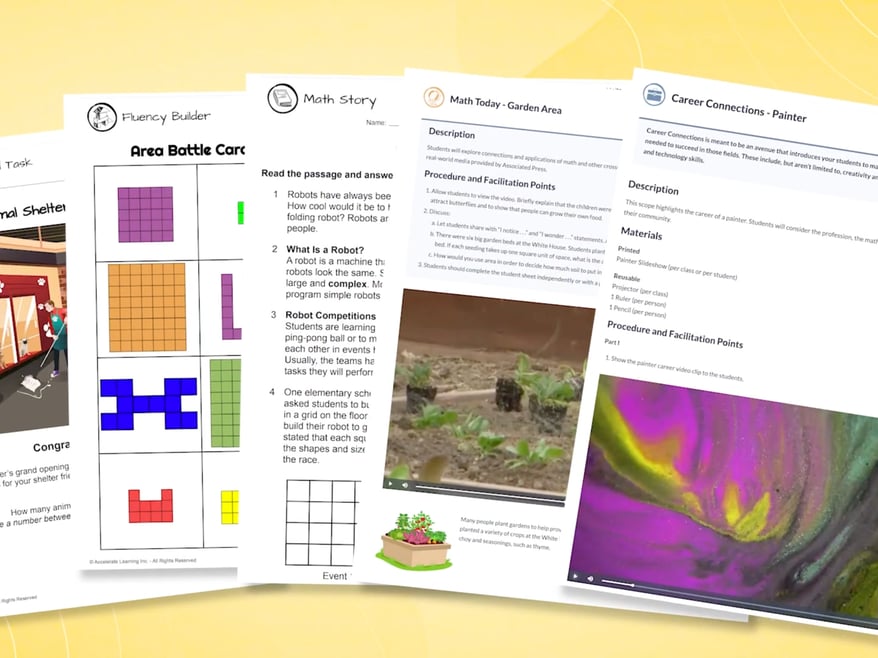
STEM skills are essential for innovation, critical thinking, and long-term success.
Students who engage in STEM early develop problem-solving habits, analytical thinking, and confidence that carry forward into later grades. Research demonstrates the advantages of STEM for academic achievement, engagement, and career readiness.
Strong STEM programs grow these skills along a K-12 continuum. Foundational skills begin in early childhood through exploration and play, then deepen over time into structured inquiry, collaboration, and advanced reasoning.
When learning builds along a progression, students are better prepared for more challenging concepts in middle and high school. They are primed to question, discover, and apply what they’re learning to the real-world.
“Children learn by observing, predicting, testing, and sharing ideas through open-ended, hands-on activities.”
Integrated, hands-on STEM instruction benefits all learners. Active investigation encourages students to ask questions, test ideas, and learn from their mistakes. Research shows that effective STEM approaches help students build critical thinking and problem-solving skills across all grade levels.
Early exposure to inquiry-based learning helps students see STEM as something they do, not something they memorize.
Students build habits of curiosity and critical thinking when they:
Accelerate Learning’s K-12 STEM model emphasizes active learning at every grade level. Lessons are designed to engage students in exploration before formal explanation, helping them connect new concepts to prior knowledge and everyday experiences.
Effective STEM instruction meets students where they are.
Scaffolded learning provides structured support to help every learner access concepts, especially English language learners, students receiving interventions, and those ready for advanced challenges.
At Accelerate Learning, we embed differentiation into every lesson, enabling teachers to adjust instruction seamlessly for students’ varied needs.
The best STEM curriculum ensures that pacing can be adapted for different readiness levels and that multiple entry points allow students to engage with content in ways that match their current understanding.
STEM lessons should include:
All of these help students explore and problem-solve at their own pace. Each of Accelerate Learning’s programs prioritize these types of problem-based learning approaches to ensure students get the best STEM curriculum that works for them and their own learning.

Introducing STEM in early childhood builds curiosity, confidence, and foundational reasoning skills. The best STEM curriculum for preschool emphasizes exploration, storytelling, and hands-on play rather than formal instruction.
What preschool educators need are lessons that come with teacher guides, videos, and printables that reduce prep time and support educators without specialized STEM training.
Additionally, built-in scaffolds help support multilingual learners and diverse classrooms, making this one of the top options for early learners.
Preschool STEM focuses on curiosity and exploration. Children learn by observing, predicting, testing, and sharing ideas through open-ended, hands-on activities. These experiences help children make sense of the world while building foundational reasoning skills.
Play-based investigations also promote essential social and emotional skills. As children work together to explore questions or solve simple problems, they practice communication, collaboration, and persistence.
They learn to express ideas, listen to their peers, test hypotheses, and navigate challenges in engaging ways.
“When learning builds along a progression, students are better prepared for more challenging concepts in middle and high school. They are primed to question, discover, and apply what they’re learning to the real-world.”
Built-in scaffolds and flexible pacing allow teachers to support students at varying readiness levels, providing reinforcement for some and enrichment for others.
This ensures every child participates meaningfully, feels challenged without frustration, and develops ownership over their learning.
Accelerate Learning delivers preschool STEM through Kide Science, a play-based program designed for children ages 3 to 8. Kide Science blends science, math, language development, and social-emotional learning with engaging investigations.
Each Kide Science lesson begins with a story challenge that frames the investigation. Stories spark imagination and invite children to predict outcomes before experimenting with materials.
Teachers receive guided questions, vocabulary support, and age-based adjustments, making inquiry-based STEM accessible in any early learning environment.
Early math concepts such as patterning, sorting, and measurement are embedded naturally into activities, strengthening reasoning skills without abstract instruction.
Elementary students benefit from structured, hands-on STEM experiences that build foundational knowledge while maintaining engagement.
The best STEM curriculum for elementary learners balances exploration with clear instructional support.
Accelerate Learning offers elementary solutions like STEMscopes Math, STEMscopes Science, and Math Nation, all designed to support inquiry-driven learning through blended delivery.
Digital resources, print materials, and physical kits work together to create consistent, high-quality instruction.
Flexible delivery is essential in elementary classrooms. Accelerate Learning’s model combines digital lessons, print resources, and hands-on kits to ensure students experience STEM concepts in multiple ways.
Digital tools provide interactive simulations, videos, and practice opportunities, while print resources offer structured guidance and reference materials.
Hands-on kits allow students to manipulate materials directly, turning abstract concepts into tangible experiences.
Turnkey kits and print materials save prep time, allowing teachers to focus on instruction instead of sourcing materials.
This approach ensures consistent hands-on learning, even in classrooms with limited time or resources, while supporting diverse learning styles.
Students build literacy by reading, discussing, and explaining STEM concepts. Math concepts are reinforced through real-world applications and problem-solving tasks.
Connecting STEM with core subjects helps elementary learners develop a stronger academic foundation and reinforces critical thinking, creativity, and problem-solving skills for later grades.
STEMscopes Math and STEMscopes Science are designed to promote interdisciplinary learning.
Middle school is a critical stage for deepening STEM engagement. Students are ready for more complex reasoning, collaboration, and real-world problem solving.
An effective STEM curriculum for middle school includes project-based learning, cross-curricular themes, and opportunities for student-led exploration. Cooperative learning and discourse become central to instruction, helping students develop communication and teamwork skills.
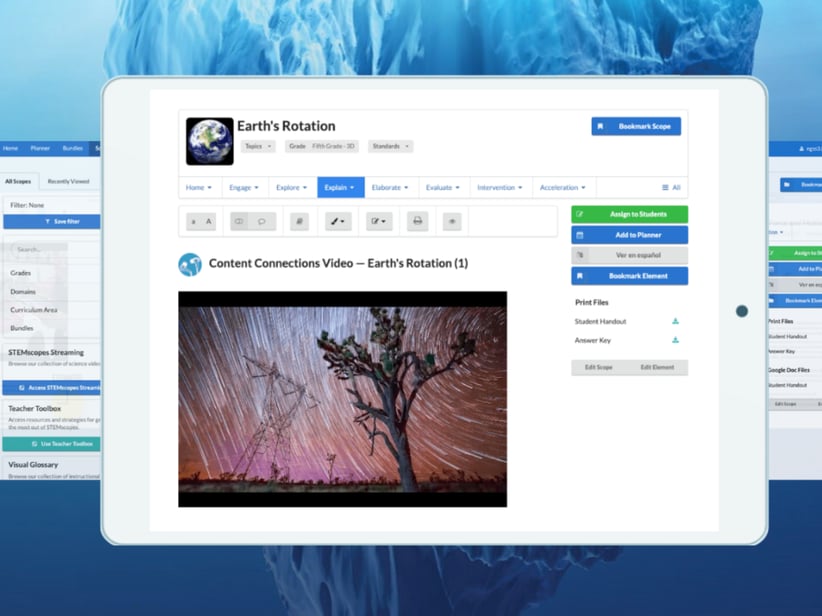
STEMscopes Science provides a complete middle school curriculum using the 5E instructional model. Lessons are designed to save prep time while supporting inquiry-based learning.
Ready-to-use investigations make hands-on science accessible in any classroom. Digital and print resources support flexible delivery and accommodate lab constraints.
Embedded intervention and acceleration supports, plus formative and summative assessments, help teachers adjust instruction in real time.
Combining the 5E model with comprehensive resources ensures middle school students develop conceptual understanding and problem-solving skills.
STEMscopes Math provides a structured lesson sequence for exploration, explanation, and application.
Lessons integrate digital and print resources, supporting hybrid classrooms and flexible instructional models. Interactive practice tools reinforce skills and promote deeper understanding.
Embedded intervention and acceleration resources ensure all students can participate meaningfully. Built-in assessments and teacher guidance make it easy to track progress and adjust instruction mid-unit.
High school STEM programs should build on earlier learning while preparing students for advanced coursework, careers, and postsecondary pathways.
The best STEM curriculum for high school emphasizes critical thinking, real-world application, and technical skill development.
Effective programs include lab investigations, digital simulations, and opportunities to explore advanced math and science topics. Flexibility and standards alignment ensure curricula meet diverse district needs.
STEMscopes and Math Nation provide standards-aligned learning for high school students. Inquiry-based labs let students design experiments, test hypotheses, and analyze results, while digital simulations allow exploration of scenarios difficult to recreate in a traditional lab.
By integrating real-world examples, these tools connect classroom concepts to authentic problems, from engineering challenges to environmental investigations and data analysis. This helps bridge the gap between theory and practice while fostering curiosity in STEM.
Math Nation offers flexible, digital math instruction aligned with high school curricula.
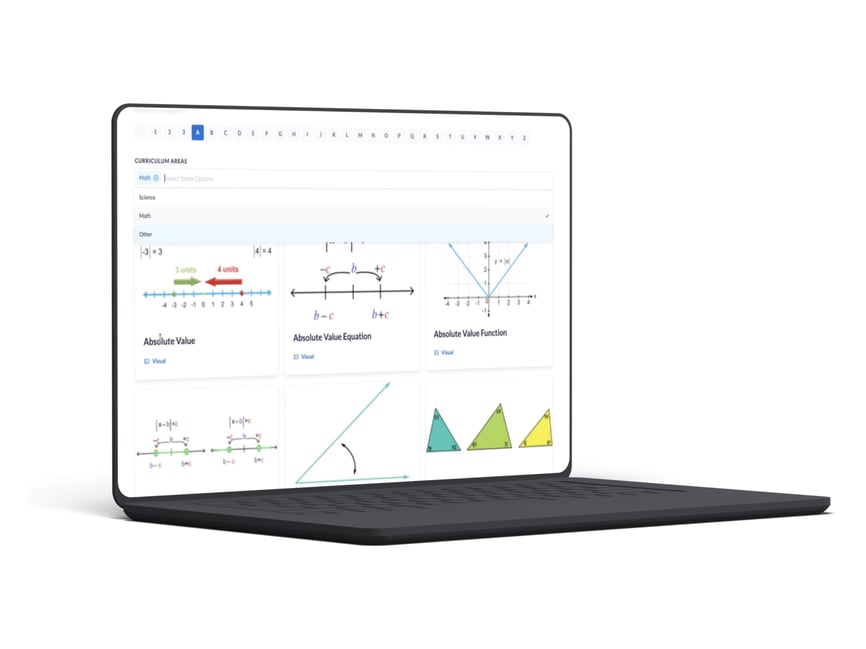
The platform supports a range of instructional models, allowing teachers to reach diverse learners. Interactive lessons, practice problems, and step-by-step guided tutorials help students reinforce core concepts while promoting independent learning and critical thinking.
Teachers can also use Math Nation to provide targeted support for students who need intervention or enrichment.
Built-in assessments, progress tracking, and adaptive resources let educators adjust instruction in real time.
Selecting the right STEM curriculum requires careful consideration. Schools should look for programs that support students and teachers while delivering measurable outcomes. Accelerate Learning’s Annual Research and Impact Report highlights measurable gains achieved by schools implementing our STEM solutions, offering insight into real district results.
A high-quality STEM curriculum should include:
The best STEM curriculum prioritizes consistency, flexibility, and engagement. Programs should offer a clear instructional framework, reduce teacher workload, and support meaningful student exploration.
High-quality curricula provide hands-on, experiential learning connected to real-world applications.
They also include embedded differentiation tools, assessments, and teacher supports to ensure all learners can access content. Accelerate Learning’s solutions meet these priorities, helping schools implement STEM with confidence and fostering teacher expertise and student growth.

Classrooms vary widely in resources, schedules, and student needs. Flexible delivery ensures STEM instruction remains accessible and scalable. Digital platforms, print resources, and hands-on kits allow teachers to adapt lessons, pacing, and group sizes without compromising quality.
This adaptability supports differentiated learning, integrates STEM with other subjects, and allows instruction to evolve as students progress.
Even the best curriculum is most effective when educators feel confident delivering it. Schools can build consistent STEM practice through district-wide professional learning. At the same time, individual teachers benefit from opportunities to pursue certification and deepen their expertise independently.
Accelerate Learning supports educator growth through NISE, which offers flexible, self-paced STEM certification and professional learning pathways. NISE can be implemented independently or alongside curriculum adoption, helping schools establish a strong STEM foundation.
NISE provides online and blended professional learning that helps educators develop effective STEM strategies across grade levels. Courses are flexible for busy educators and help establish a shared instructional framework across schools and districts. This improves consistency and readiness for future curriculum implementation.

Hands-on, inquiry-driven STEM learning transforms classrooms. When students see how STEM connects to their lives, curiosity turns into exploration, and exploration becomes understanding.
Accelerate Learning offers proven preschool and K-12 STEM solutions, including STEMscopes Math and Science, Math Nation, and Kide Science. With hands-on kits, flexible digital platforms, and robust professional learning through NISE, schools have everything they need for successful implementation.
Explore the best STEM curriculum for schools and take the next step toward engaging, future-ready instruction. Schedule a demo or preview of Accelerate Learning’s programs.
Strong elementary math foundations begin with understanding, not memorization.
When students move from hands-on...

As Back-to-School kicks into gear, we’re highlighting how to build great STEM classrooms and set your school year up...

The strongest start to a STEM school year isn’t about decorating a classroom or creating a perfect syllabus.
It comes...


