.png?width=552&height=414&name=Choosing%20a%20Math%20Curriculum%20(2).png)
The Case for Strong Elementary Math Foundations
Strong elementary math foundations begin with understanding, not memorization.
When students move from hands-on...

Are students in your science classrooms merely completing activity after activity and moving on? Or do they have a chance to ask questions, test ideas, and explain what they discover? Where engagement isn’t forced and curiosity drives the work?
Classrooms like the latter do not happen by accident.
Schools and districts need the right science curriculum. A curriculum that supports teachers and engages students.
As districts plan for 2026 and beyond, choosing the best science curriculum means more than checking standards boxes. The strongest programs also make teaching easier and help students think like real scientists.
This guide explains what districts should look for when reviewing science curricula, with a focus on long-term success for teachers and students.
“When students are curious, learning happens naturally.”
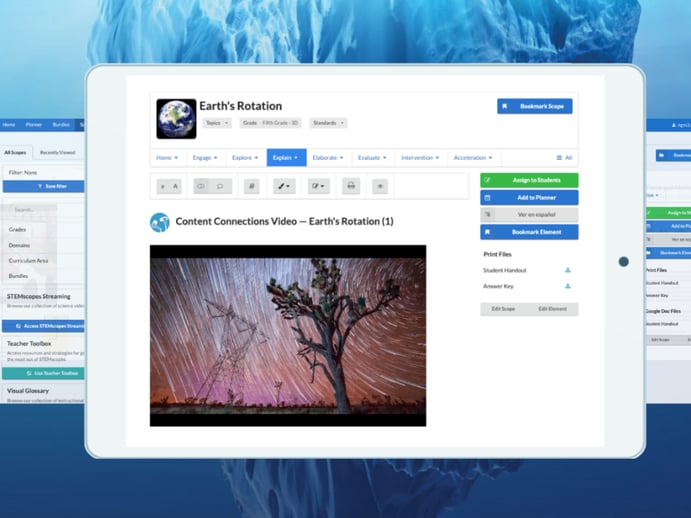
Standards still matter. But in 2026, they are not enough on their own.
Districts need science curricula that treat learners like scientists, work in real classrooms, and support how teachers teach every day.
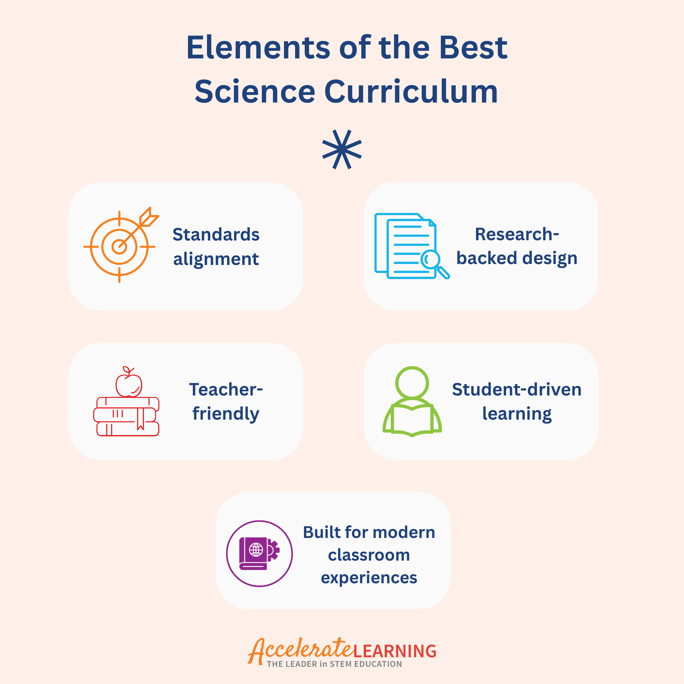
Here are elements of the best science curriculum:
Standards alignment. NGSS is more than a checklist. Look for a program that blends Disciplinary Core Ideas, Science and Engineering Practices, and Crosscutting Concepts seamlessly. That way, students see how everything connects, instead of learning isolated facts.
Research-backed design. Students learn science by actually doing science. The strongest curricula let students investigate, test ideas, and discover patterns. They build understanding through experience, not memorization.
Teacher-friendly from day one. Great curricula respect teacher time and expertise. Teachers should not spend time Sunday nights creating activities from scratch. They should be able to focus on actually teaching.
Students drive the learning. Every lesson starts with something that learners can actually wonder about, not an empty “problem”. Real phenomena they can observe, question, and explore. When students are curious, learning happens naturally.
Built for today's classrooms. Whether your classrooms are in-person, hybrid, or technology-first, the curriculum adapts to your needs.
Many science programs look strong on paper.
But when teachers try to implement them in real classrooms with real students, many challenges come to the surface.
“Districts need science curricula that treat learners like scientists.”
Teachers may find lessons hard to use or activities do not connect with specific students. Units might not be aligned with actual standards. Or there might not be enough support for different learning styles.
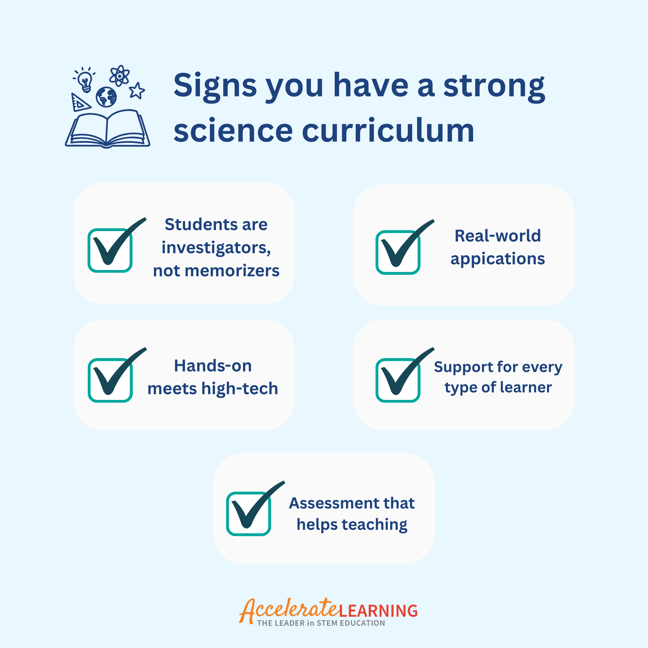
To avoid these problems, districts should focus on a few key signs that show whether a curriculum will work in practice:
Students become investigators, not memorizers. Watch for curricula that put students in charge of finding answers. They should be asking questions, gathering evidence, and drawing conclusions. This mimics the work of real scientists.
Real-world connections. The best programs start each unit with authentic phenomena that students can see and touch.
Hands-on meets high-tech. Look for curricula that balance physical experiments with digital tools.
Support for every learner. Classrooms have English learners, advanced students, and everything in between. Strong curricula provide scaffolding and extensions without extra work for teachers.
Assessment that helps teaching. Quick formative checks should be built right in. Teachers need to know if students understand before moving forward, not after the unit test.
Three and four-year-olds love to explore. They ask questions about everything and test ideas by trying things out.
Strong early childhood science curricula capitalize on this by turning science into play. Imagine preschoolers becoming weather detectives, investigating how germs spread, or looking for a way to fix a broken toy. Young learners learn science when they act out scenarios and take part in hands-on investigations.
The best preschool science curricula also help students explore the world around them.
Simple activities work best for this age. Think about using measuring cups and magnifying glasses, not fancy lab tools. Integrated STEM curricula incorporate activities that help with reading, math, and social skills.
Kindergarten students are ready for more structure, but they still need hands-on learning. Science curricula must balance guidance with active exploration.
The best science curriculum for kindergarten balances structure with hands-on learning.
Strong kindergarten science programs are also aligned to NGSS or state standards, with content designed especially for young learners. Lessons should focus on simple ideas that students can observe and explore with their eyes and hands, not abstract explanations.
The strongest kindergarten science programs also use movement, touch, and simple tools to support learning.
Hands-on activities that include multiple senses help students stay engaged and build understanding. Strong kindergarten STEM programs also support English learners with built-in literacy connections.
Kindergarten schedules vary across the country. Some programs run all day, while others meet for only a few hours. Effective science curricula offer flexible lesson options that fit different schedules without losing instructional value.
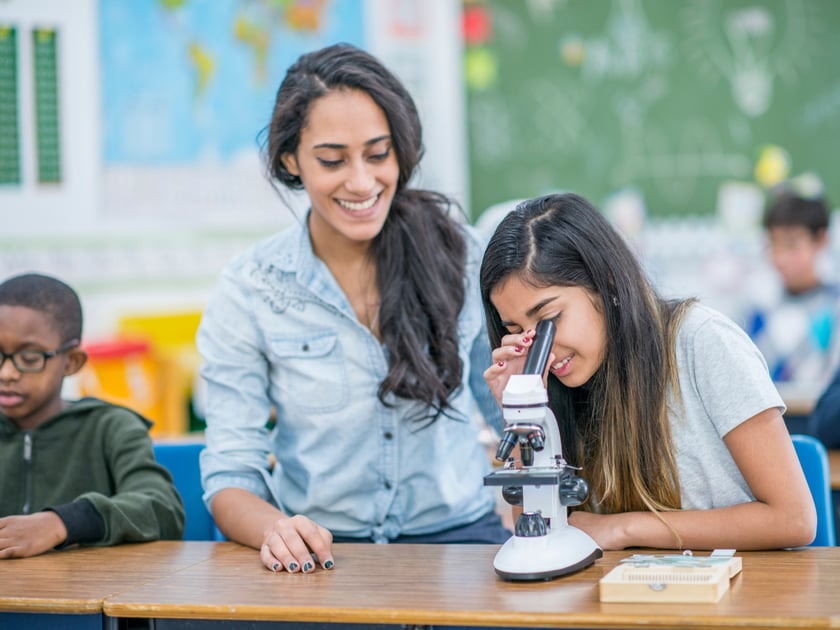
Elementary students are ready to think like real scientists.
They can form hypotheses, conduct investigations, and analyze data with help. The best elementary science programs use this readiness.
Strong elementary science curricula are aligned to NGSS and use three-dimensional learning. Science and Engineering Practices, Disciplinary Core Ideas, and Crosscutting Concepts work together so students learn how scientific ideas connect.
High-quality programs also ground learning in investigation.
Lessons begin with phenomena students can observe and explore. Then students gather evidence, discuss ideas, and explain what they learned.
Some curricula extend this work through project-based learning, where students solve real problems like building strong structures or studying plant growth. Programs such as Collaborate Science support this approach by guiding students through clear questions and steps.
Elementary science learning is stronger when it connects to other subjects. Many programs include reading, writing, and math within science lessons. Students read about science, write short explanations, and work with basic data.
Optional enrichment, such as engineering challenges and STEM career connections, gives students more ways to extend learning.
Strong science curricula also support actual teaching. Built-in formative assessments help teachers check understanding and adjust instruction. Many programs include both print and digital materials so lessons can work in different classroom settings.
At the middle school level, students can handle more complex science ideas, and they need curricula built specifically for their age group.
Strong programs must match how adolescent learners think and grow.
Many middle school science programs include lessons on Earth, Life, and Physical Sciences. The best science curriculum programs not only align with NGSS but also teach in an integrated way. This allows students to connect ideas across different areas instead of thinking of them as separate subjects.
For this age group, inquiry-based investigations need to support evidence-based reasoning and feel authentic.
Middle school students can design controlled experiments, analyze complex data, and draw conclusions from different sources. Strong curricula require students to explain their thinking with real evidence, not just follow steps.
“Teachers need ongoing support as they plan lessons, teach investigations, and respond to student questions.”
The best science programs pair hands-on labs with digital simulations and visual tools.
This helps support different types of learners, from special education students to English Language Learners. Hands-on activities help students understand ideas they can touch and change.
Simulations let them explore processes that are too slow, quick, or dangerous to observe in real labs.
Look for science programs that also have these important features. Writing prompts built directly into lessons help students develop scientific communication skills.
Formative assessment tools that give teachers ways to respond quickly to student needs and catch misconceptions early. Also make sure that whatever program you use works across traditional, hybrid, and 1:1 classroom models for maximum flexibility.
Accelerate's Collaborate Science adds project-based learning that challenges middle school students to solve complex, real-world problems using scientific methods and teamwork skills.

High school science curricula prepare students for college and future careers. The most effective programs must cover advanced content while supporting many different learners.
Strong high school science programs are aligned to NGSS and include full courses in Biology, Chemistry, Physics, and Integrated Physics and Chemistry (IPC).
These courses cover key ideas while allowing schools to meet graduation requirements. Strong programs ensure students meet both state standards and college entrance expectations.
Many advanced science concepts are hard to observe directly.
Topics like molecules, waves, and Earth systems need visual support. Quality high school science curricula use technology to make these invisible phenomena accessible and meaningful.
High school classrooms include students with many learning needs. So it’s important to select programs with built-in supports for differentiated instruction.
The best science curriculum will provide both scaffolding for struggling students and extensions for advanced learners.
They should also include integrated literacy strategies with embedded reading and writing practice that prepares students for college and career success.
Finally, choose curricula with modular content that allows flexible delivery across different high school course structures. Whether your school uses traditional semester courses, block scheduling, or alternative formats, strong programs adapt without losing essential content or rigor.
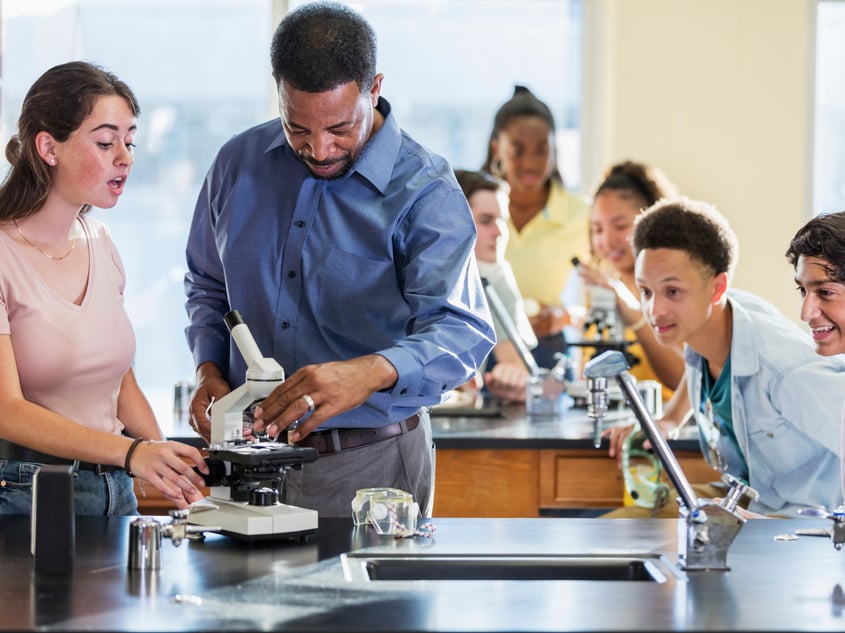
Today's science curricula must include strong digital tools that make teaching easier and learning more engaging.
“Choosing a science curriculum means balancing standards, student learning, teacher support, and flexible tools.”
School districts should seek programs that offer complete digital support, not just add-on features.
Here are technology features that the best science curriculum will offer:
STEMscopes Science provides exactly this kind of digital-first platform. Teachers get online access to lessons, assessments, simulations, and dashboards that track student progress.
The program works seamlessly in traditional classrooms, remote learning, and hybrid environments. Teachers can personalize instruction, monitor standards mastery, and manage their classrooms more efficiently.
Like all of the best science programs, STEMscopes Science is built around a foundation of the elements of great science curriculum discussed at the beginning of this article. All school districts should use those elements as a guiding principle when choosing their science curriculum.

Even the best science curriculum will not succeed without support for teachers.
Professional learning helps teachers use materials with confidence and consistency. Strong implementation and onboarding support are vital to ensure smooth program adoption and quality across districts and schools.
One-time training is not enough. Teachers need ongoing support as they plan lessons, teach investigations, and respond to student questions.
Effective professional learning entails:
Clear guidance
Practice time
Resources teachers can use right away
The National Institute for STEM Education (NISE) is a strong option for professional learning.
For districts and schools, it offers campus-wide training that builds shared instructional practices. Individual teachers can also strengthen specific STEM teaching skills through micro-certifications. And this flexibility is what makes NISE particularly valuable. Importantly, unlike other training programs, NISE can be adopted independently of curriculum.
This supports long-term instructional improvement regardless of what materials schools use.
Beyond independent training programs, schools also benefit from curriculum-specific support.
Accelerate Learning provides comprehensive curriculum support through customized onboarding, professional learning sessions offered both virtually and in person, and on-demand teaching resources with embedded instructional videos.
This ensures smoother adoption and sustained instructional quality across district teams.
Choosing a science curriculum means balancing standards, student learning, teacher support, and flexible tools. Strong programs make it easier for teachers to teach and help students think like scientists.
Ready to strengthen your district's science instruction? Through STEMscopes Science and Collaborate Science, Accelerate Learning supports districts with NGSS-aligned curriculum and professional learning designed for K–12 success.
Strong elementary math foundations begin with understanding, not memorization.
When students move from hands-on...
As Back-to-School kicks into gear, we’re highlighting how to build great STEM classrooms and set your school year up...

The strongest start to a STEM school year isn’t about decorating a classroom or creating a perfect syllabus.
It comes...


