.png?width=552&height=414&name=Choosing%20a%20Math%20Curriculum%20(2).png)
The Case for Strong Elementary Math Foundations
Strong elementary math foundations begin with understanding, not memorization.
When students move from hands-on...

Professional learning communities (PLCs) are growing in education, but not all communities are created equal.
Many schools have adopted such a loose definition of professional learning communities that they scarcely resemble any structured process at all.
So let’s set the record straight: professional learning communities in education bring teachers together in a consistent and structured process to examine student learning, share instructional practices, and make collective decisions about how to improve outcomes.
Professional learning communities in education are not:
In education, professional learning communities in their truest forms are a cultural and operational commitment to continuous, job-embedded learning.
They can be organized by grade level, content area, or school-wide focus.
While many outdated models of professional learning are organized around time and scheduling, PLCs are defined more by purpose and structure.
This ensures teachers can get to the heart of what authentic PLCs are designed to do: develop a consistent habit of collaboration aimed at improving tangible student outcomes.
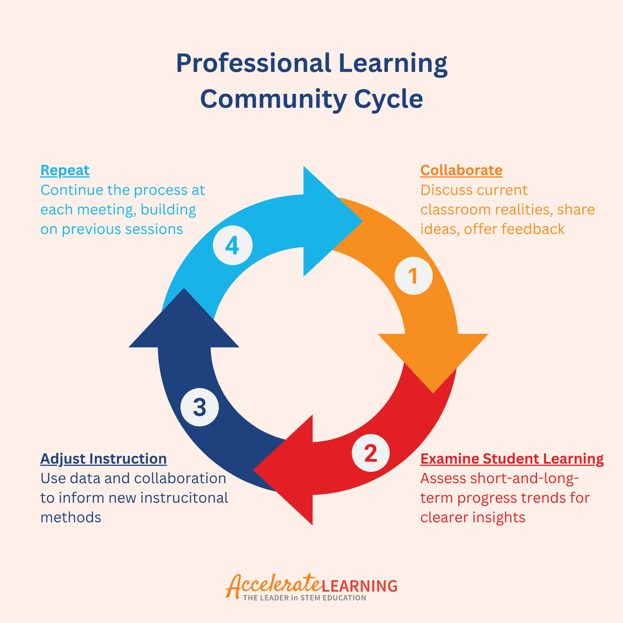
Schools need designated professional development for teachers that exceeds surface-level check-ins. Professional Learning communities for teachers offer the time and space to analyze data, test instructional approaches, and build a shared understanding of strong teaching.
A solid PLC should facilitate collaboration, giving teachers a greater capacity to observe classroom patterns and apply fresh approaches in a supported environment, rather than isolated trial and error.
“When teachers share feedback and ideas, a shift occurs in their approach to student progress. Instead of one teacher managing dozens of students’ progress alone, the responsibility falls on the whole group–something all teachers are working on together.”
By sharing ideas and actionable feedback, teachers gain greater STEM instructional support, which directly impacts student progress. This is particularly useful during curriculum transitions when teachers are trying to apply best practices in uncharted territory.
Teachers in a supportive PLC also gain access to team-wide knowledge, preventing anyone from having to figure things out alone.
At the core of every PLC is a commitment to improve instruction. With better instruction, students have the support they need for daily progress and long-term retention.
Teachers in a PLC can critique instructional practices together, examining student learning both in broad strokes and daily experiences.
This collaboration enables teachers to catch mistakes earlier, adjust faster, and align instruction across classrooms for greater consistency.
Sharing insights and responsibilities makes it easier for individual teachers to focus more on the daily experiences that shape student learning, like making learning fun through engaging math instructional strategies.
When teachers share feedback and ideas, a shift occurs in their approach to student progress. Instead of one teacher managing dozens of students’ progress alone, the responsibility falls on the whole group–something all teachers are working on together.
Schools that sustain PLCs over several years see benefits increase with time. Teachers in a PLC naturally build on what they learn in each cycle, meaning that when schools invest in PLCs for the long term, they see an increasing payoff each year as teachers continue to learn and build on their experiences.
Several conditions distinguish a high-functioning PLC from other professional meetings. To start with, all teachers are united by a shared commitment to improving student learning.
Motivated by this foundation, teachers agree upon the norms and protocols that will guide their collaboration, such as which content areas will be discussed and their scheduled time.
Teachers can then dive into actionable student data, identifying patterns and uncovering weak spots. These insights will inform the rest of the collaboration process, ensuring each meeting drives actionable takeaways.
Repeating this cycle at each meeting helps educators make continuous instructional improvements during protected professional learning time.
This consistency also ensures teachers have enough time for subject-specific discussions, collaborating on content and pedagogy in particular subject areas.
As challenges arise in the classroom, a PLC serves as the go-to hub for collaboration, where challenges are treated as a shared professional commitment rather than one teacher’s weakness. Creating an environment that reflects that commitment is as deliberate as designing the structure.
This is exactly the type of environment Uinta County School District #1 cultivates in its bi-monthly PLC meeting, when teachers and leaders gather to discuss curriculum, instructional strategies, student data, and shared planning.
The district’s commitment to professional learning not only improves instruction, it also supports teachers by making student progress a collective responsibility:
“[Our teachers] truly believe that every student in the district belongs to the PLC, whether they’re at Aspen, Clar, North, or Uinta Meadows. They believe we are all responsible for each child’s learning.”
Far from just a meeting, the district’s PLC is a highly effective system for teachers to examine student data, find opportunities for improvement, and plan next steps together:
“Our teachers look at the data to see what’s working well and what can be improved, and they do shared planning to move forward from there.”
|
High-functioning PLC |
Surface-level PLC |
|
|
What the team focuses on |
Student learning, instructional practices, and shared goals |
Logistics, announcements, and administrative tasks |
|
How time is used |
Collaboration, data analysis, and planning next steps, |
Sharing updates, exchanging resources, and discussing problems without clear solutions |
|
What happens with student data |
Data is examined collaboratively to identify trends, needs, and next steps |
Data is reported rather than analyzed and interpreted |
|
What teachers leave with |
Clear action items, instructional adjustments, and collective accountability |
Information, meeting notes, and minimal takeaways |
Establishing an effective PLC takes time and intentional planning. Too often, schools start with a broad idea of a PLC that quickly slips to surface-level meetings.
To prevent this, schools should avoid some of the common obstacles that can steer a PLC off course:
In a school where leaders don’t protect PLC time or model its value, teachers may conclude that professional learning is merely optional.
A strong commitment to PLC time, as well as a district-wide culture that supports professional learning, will set both teachers and students up for long-term success.
Most teachers are accustomed to generic professional development–check-ins, workshops, and sporadic meetings–that usually only scratch the surface of classroom realities. But these fall short in giving teachers the collaborative support needed to address challenges, especially in technical subjects.
STEM education requires a level of subject-specific depth that general professional development rarely reaches.
STEM teachers who want to make greater instructional improvements need ongoing support from a PLC, where teachers can collectively build content knowledge and pedagogical confidence that individual preparation alone can’t replicate.
“To build a culture of professional learning and increase teacher buy-in, leaders should make an effort to actively engage in PLC work, rather than simply oversee it.”
Math teachers in particular face unique challenges that directly benefit from collaborative inquiry.
Receiving support in productive struggle, building confidence in math, implementing problem-based models, and searching student work for mathematical thinking rather than accuracy alone are some of the many responsibilities that math teachers manage on a daily basis.
With a PLC, these subject-specific realities can be shared with colleagues, helping teachers internalize new instructional approaches and refine their practice over time.
Structured PLC time, especially for STEM educators, accelerates teacher learning during a new curriculum rollout, converting hesitation into confidence. Brownsboro ISD ensured their teachers were prepared for STEMscopes in the classroom by using their PLC time to introduce teacher supports, such as set-up videos:
“Teachers were really excited about those,” said Michelle Wood, Instructional Coach at Brownsboro ISD, “they could watch the videos and off they went.”
As districts work to sustain collaborative learning in their schools, STEMscopes Professional Learning, in partnership with the National Institute for STEM Education, guides educators and leaders in managing PLC time and facilitating meaningful change for both educators and students.
Coaches and consultants work to strengthen quality teaching, preparing students for a life in STEM through evidence-based instructional strategies. With ongoing professional learning, STEM teachers can be confident they’re deepening their subject expertise while improving student outcomes.

School and district leaders have the most direct influence over whether PLCs become a genuine engine of improvement or simply a scheduled obligation.
The first thing leaders need to do is protect PLC time and resources, showing teachers that a commitment to a PLC is not merely optional, but rather a solidified part of the master schedule.
To build a culture of professional learning and increase teacher buy-in, leaders should make an effort to actively engage in PLC work, rather than simply oversee it.
Their participation reinforces the district’s commitment to professional learning and sends a positive signal to teachers that their work is worthwhile.
From this foundation, leaders then need to build an effective framework for PLCs by setting clear expectations for meeting focus and outcomes, and ensuring teachers have access to the data and resources they need.
The more leaders can reinforce the connection between PLC and student outcomes, the more teachers will see that their investment is working.
Furthermore, connecting PLC work to the curriculum teachers are already using gives meetings a clear instructional anchor and solidifies the direct PLC-to-classroom impact.
In the math classroom, quality instruction is one of the strongest drivers of student success.
Teachers who continually seek out effective math instruction give students a better chance to build mathematical understanding and confidence. Leaders who prioritize professional learning for STEM teachers create the conditions for stronger teacher expertise, higher test scores, and better engagement.
Building a sustainable PLC culture takes time, and leaders should approach the process as a long-term investment more than a short-term project. With sustained district support, schools can expect their PLCs to stand the test of time and provide meaningful change for teachers and students for years to come.
The key to sustaining a PLC starts with fostering a collaborative culture among teachers.
Schools investing in ongoing support through coaching, facilitation, or partnerships like the National Institute for STEM Education (NISE) foster that collaborative culture more effectively than those relying on initial training alone.
Wilemon STEAM Academy sustains its PLC by intentionally creating a school-wide culture of professional learning:
“We were all learning at the same time,” said Kate Authier, Principal, at Wilemon STEAM Academy. “It helped me see how to support our teachers, and it brought us all closer together.”
Through their shared commitment to STEM professional development, school leaders are making teachers feel supported and excited about their work:
“We love our jobs here because of what we learn through NISE”, said Lace Trout, fourth grade teacher, Wilemon STEAM Academy. “It’s a different way of teaching–and I wouldn’t go back for one second. I’ve been teaching for 16 years and these last five years have been the most fun and rewarding years I’ve ever had. My students love to learn.”
Like Wilemon STEAM Academy, schools that see the greatest long-term benefits of PLCs treat their development as a multi-year investment, not a fixed rollout.
Sustaining a PLC means revisiting norms and goals each year, onboarding new teachers into the collaborative culture, and regularly tracking student data to see how professional learning is making a difference.
Since PLCs are designed to help teachers address present-day issues, it’s important to allow groups to evolve as teachers grow.
A third-year PLC will look different than one in its first year, simply because the needs of teachers and students will change over time.
“The more leaders can reinforce the connection between PLC and student outcomes, the more teachers will see that their investment is working.”
As a PLC grows and teachers become more committed to collaboration and improvement, the group will become virtually self-reinforcing.
The more teachers commit to it, the stronger it becomes, until they apply the same qualities they experience in the group–collaboration, reflection, and taking action–into every area of their practice.
Teachers face more demands now than ever before, as they work to guide students through the always-advancing field of STEM.
Teachers need ongoing support from a professional learning community to effectively improve instruction and facilitate positive change in the classroom.
STEMscopes Professional Learning and NISE are among the helpful resources schools are turning to in their efforts to sustain PLCs.
Whether schools want to strengthen existing models of professional development or build a community from the ground up, these tools equip schools with the right structure, support, and partners who understand STEM instruction from the inside.
See what revitalized professional learning can do for your school today.
Strong elementary math foundations begin with understanding, not memorization.
When students move from hands-on...

As Back-to-School kicks into gear, we’re highlighting how to build great STEM classrooms and set your school year up...

The strongest start to a STEM school year isn’t about decorating a classroom or creating a perfect syllabus.
It comes...


