.png?width=552&height=414&name=Choosing%20a%20Math%20Curriculum%20(2).png)
The Case for Strong Elementary Math Foundations
Strong elementary math foundations begin with understanding, not memorization.
When students move from hands-on...


Most students who struggle in math aren't missing years of learning.
They're missing one small skill, and that gap might block everything above it.
Building math readiness means finding that exact skill and filling it, without sending students backward through content they don't need to access at that moment.
That's a different goal than remediation, and it requires a different kind of program.
This guide breaks down how to identify those gaps the right way, what gets in the way of finding them, and how the right support can get students back to grade-level math with confidence.
Missing foundational math skills don't tend to announce themselves.
They might be hiding inside incorrect answers, math anxiety, and a quiet disengagement in the math classroom that grows over time. Without the right tools to pinpoint them, educators are often left guessing, and students are left behind.
These students aren’t incapable. They’re missing an essential piece in their math journey that makes what they’re currently learning less accessible, and the stakes are real.
Research from the Learning Policy Institute points to the importance of students experiencing success in math early and often. When students feel competent, they engage more deeply. When they feel lost, the opposite happens.
What makes this especially challenging is that confidence and skill readiness are deeply connected.
A student who's missed a prerequisite skill might struggle academically and start to believe they're bad at math. Identifying those gaps precisely matters not just for learning, but for how students see themselves as mathematical thinkers.

The good news is that when students receive the exact support they need, they can approach grade-level math with renewed confidence.
This doesn’t mean a broad remediation package, but targeted help for the specific skill they're missing to support forward momentum. Math strategies for struggling students emphasize differentiation and flexibility, but differentiation only works when you know exactly what to target.
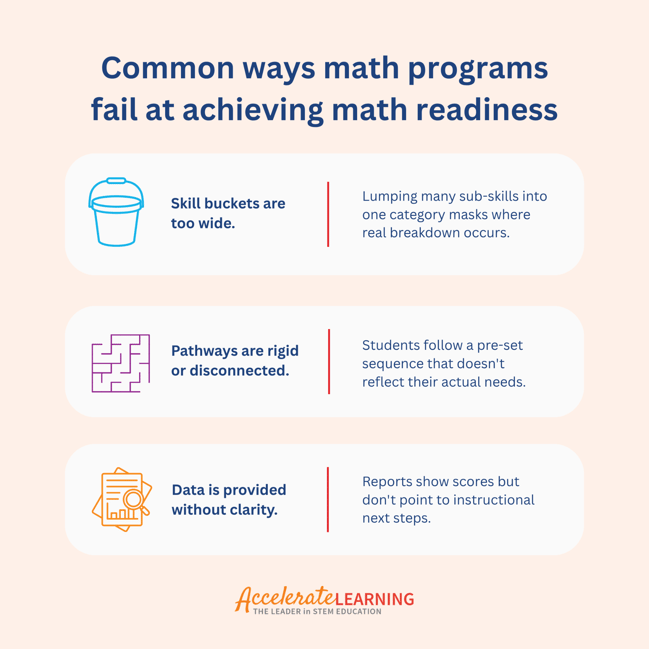
Most supplemental tools are built around broad, domain-level diagnostics.
They can tell you a student is struggling with fractions or ratios, for example, but they can't tell you why. It’s accurate, but might not be particularly useful if you’re coming up with actionable steps to help your students succeed.
When diagnostic data is too broad, the instructional response is too broad.
Students might get placed into remediation pathways that cover content that won’t fill those missing pieces. Teachers get dashboards full of data that's hard to translate into action and boost student achievement, and the actual gap, or that one small prerequisite, isn’t clear.
Here are some common problems with programs that miss the mark on math readiness:
What teachers actually need is simple: a clear answer to which skill is missing and a direct path to addressing it.
Efficient, precise gap identification doesn't have to mean long diagnostic testing cycles.
The most effective approach is one that fits within a single class period and zeroes in on the skills that actually matter for what students are learning in your classroom now.
A supplemental math program like On-Ramp Math can be implemented to help students hone those skills. It uses a brief initial readiness assessment designed to determine which essential skills a student needs before they can fully participate in current grade-level instruction.
It's not a comprehensive screen or a placement test, but a targeted readiness check.
From there, Quick Concept Checks (“Pit Stops”) built into Target Skills serve as an in-the-moment verification as students move through the instructional cycle. This isn't additional testing but a way to confirm students’ understanding before moving on.
The result is a classroom-friendly process that avoids the trap of over-assessing students while still giving educators exactly the information they need to plan instruction.
Once gaps are identified, the work of strengthening foundational math skills begins.
This should happen at the exact skill causing the breakdown. Broad diagnostics that miss root causes lead to broad interventions that waste valuable instructional time. Identifying the specific skill gap leads to targeted support that moves students forward.
On-Ramp Math is built around two interconnected skill types that create a clear, logical path from where a student is to where they need to be.

Target Skills are the grade-level readiness skills a student must master to participate meaningfully in current instruction. They're the specific skills tied to what's being taught now, aligned to the course a student is actually taking.
A student who clears a Target Skill is ready to engage with grade-level content. Success at this level is the goal, and everything in the program is oriented toward getting students there.
Supporting Skills are the prerequisite building blocks beneath each Target Skill. When a student struggles with a Target Skill, it's often because one or more Supporting Skills haven't been mastered yet.
This structure does something that most programs can't: it isolates exactly where the understanding breaks down.
Crucially, students only work on the Supporting Skills they actually need.
There's no unnecessary backtracking through content they already understand, and no hit to their confidence from covering old ground they've already mastered.
For teachers, this means a clear look at the root cause of each student's struggle. For students, it means focused, manageable support that builds momentum and confidence in math.

Identifying a gap is only the first step. The instructional support a student receives next is what actually determines whether they get unstuck or stay there.
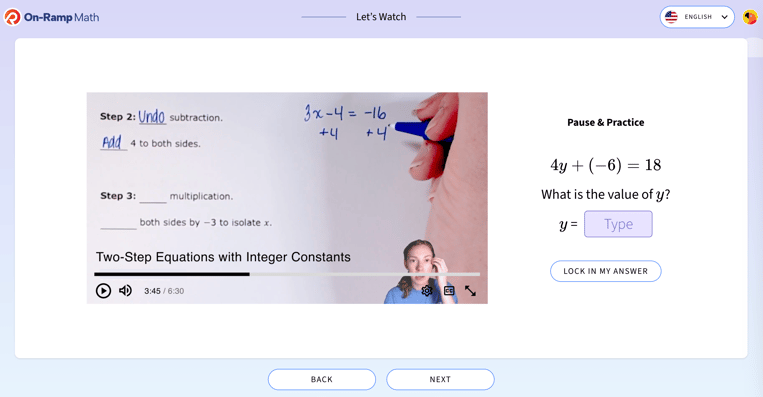
On-Ramp Math doesn't just diagnose students. It guides them through a short, adaptive instructional cycle designed to address the specific skill they need when they need it. The support is timely, targeted, and confidence-building, and it doesn't require a teacher to be standing next to a student to work.
This kind of targeted math intervention is what separates a program that points at a problem from one that actually helps solve it.
When a student hits a roadblock on a Supporting Skill, On-Ramp's three-part support cycle kicks in automatically:
Each step adapts based on what the student needs. The cycle is designed to restore understanding and get students unstuck without requiring constant teacher intervention.
When students can work through a challenge and come out the other side successfully, they start believing they can do it. That’s almost as important as the skill itself.
Teachers and instructional leaders already have so many demands on their time. The last thing they need is a dashboard that adds to it.
On-Ramp Math's reporting is built around clarity, not volume.

Data is organized at the skill level. Educators can see at a glance exactly which students need support on which specific skills, rather than a sea of percentages that require interpretation before they're useful.
An Academic Intelligence layer provides meaningful patterns across classrooms, helping instructional coaches and school leaders spot trends and make informed decisions.
Math readiness is only achievable when educators have clear, actionable information. A dashboard that overwhelms does just as much damage as a diagnostic that's too broad.
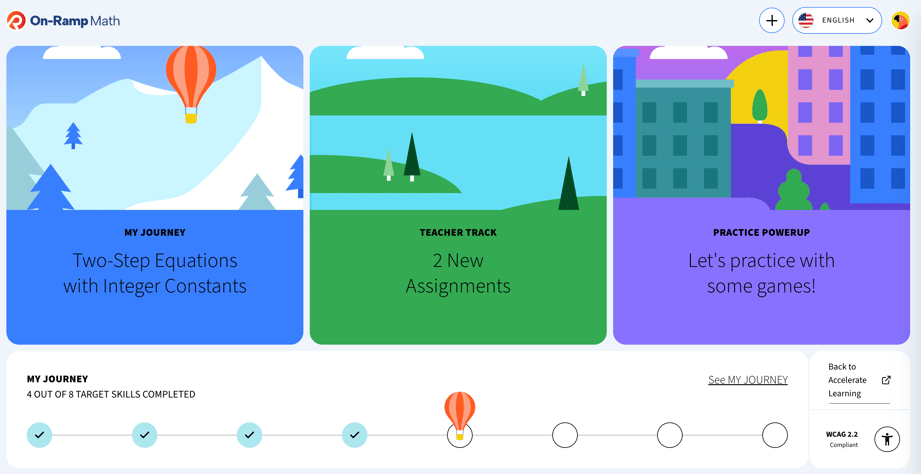
No two classrooms are the same, and choosing a math program that works in one setting has to be flexible enough to work in another. On-Ramp Math offers three complementary pathways that balance adaptive technology with teacher control:
On-Ramp Math works how a teacher needs it to. Whether educators want a fully adaptive experience, prefer to assign skills themselves, or mix both approaches, there's a pathway that fits.
It supports intervention, acceleration, and daily lessons without adding to teacher workload, and helps students build independence and confidence along the way.
On-Ramp Math is not a remediation program. Remediation looks backward. It sends students back to content from prior years in hopes of filling in everything they might have missed.
The result is often more time spent on material that isn't connected to what their class is doing now.
Math acceleration identifies the precise gap that's blocking current participation, fills it with targeted support, and gets the student back to grade-level instruction as quickly as possible. That's what math readiness should look like in practice, and research supports this.
Studies on skill-based prerequisite gaps suggest that targeted support matched closely to what a student needs outperforms broad remediation for skill acquisition and student motivation. On-Ramp Math is built on this principle from the ground up:
When students get the right support at the right time, they don't just catch up. They build the confidence to stay caught up.

Every student deserves to walk into math class feeling ready and good about themselves.
They shouldn’t feel lost or left behind, or struggling because of some minor gap that no one has quite managed to identify.
On-Ramp Math makes that possible through targeted support, personalized pathways, a guided instructional cycle, and clear, actionable insight for educators.
It strengthens foundational math skills without overwhelming the teachers who are doing the work of building them.
If you're looking for a smarter way to build math readiness across your classroom or school, explore On-Ramp Math.
With the right math program, you'll see what it looks like when every student has exactly what they need to ramp up to grade-level math with clarity, confidence, and momentum.

Strong elementary math foundations begin with understanding, not memorization.
When students move from hands-on...

As Back-to-School kicks into gear, we’re highlighting how to build great STEM classrooms and set your school year up...

The strongest start to a STEM school year isn’t about decorating a classroom or creating a perfect syllabus.
It comes...


